
This content was created in partnership with Arrcos Golf.
I have been a 19 handicap for four years.
Not a bad 19. I make solid contact, I hit my fairway irons well, and every few rounds I put together a stretch of holes that makes me think something has finally clicked. Then I shoot a 92 again. Four seasons of lessons, a new driver, one putter I still regret, and the number never moved.
What I told myself, and what I told anyone who asked, was that I couldn’t putt. It felt obviously true. I could recall three or four missed four-footers from any given round, and I could not recall a single one of my approach shots. So I bought the putter. I rolled balls on the practice green before every round. I shot 92.
In March I bought an Arccos Air, mostly because a guy in my regular group had one and would not stop talking about it. My expectation was that it would confirm what I already knew about my putting and I’d have a nice chart to look at.
The setup took about 2 minutes. It knew what course I was playing on, I clicked Start Round, put it in my pocket, and mostly forgot about it.
I had looked at shot trackers before and been put off by the sensors. Screwing fourteen of them into my grips, keeping track of which is which, replacing the ones that fall out. A friend of mine lost two in one season and stopped bothering.
The first few rounds with Air didn’t really do anything for me. The data was accumulating, and I shot my normal 91, 94, 89, 93, and 90.
What I did start looking at was Strokes Gained, which breaks your round into four buckets: driving, approach, around the green, and putting. It compares each one against a benchmark rather than against your own memory.
Turns out my putting was fine.
Not good. Fine. Average, for my handicap. Slightly above it on a couple of rounds. Four years of blaming my putter, four years spending extra time on the practice green before and after rounds.
If it wasn’t my putter, then what was it? The strokes were going somewhere else and I was determined to find where I was leaking shots.
The app showed me it was my pitching wedge that was failing me. I hit it roughly ten times a round once you count approach shots and everything from just off the green. I was pretty confident that I hit my pitching wedge about 120 with a full swing. It actually goes about 106.
That number came from every pitching wedge I hit across ten rounds, in the actual conditions I play in, not the one I flushed downwind on a warm day in 2022 that apparently became my permanent reference point. Fourteen yards of difference. Every single time I stood over a 120-yard approach and pulled the pitching wedge, I was playing a shot I could not hit.
Once I saw it, the rest of my scorecard made sense. I wasn’t missing greens sideways. I was missing them short. Short means the bunker, or the false front, or the collar with the pin tucked behind it, and from there I’m chipping to save bogey. Then I’d two-putt and write down a five, and the number I remembered from that hole was the putt.
That’s the part that bothered me. It wasn’t that I had a bad wedge distance. It’s that the shot that cost me the stroke and the shot I blamed were two different shots, three minutes apart, and I’d been getting it wrong for four years.
Golf
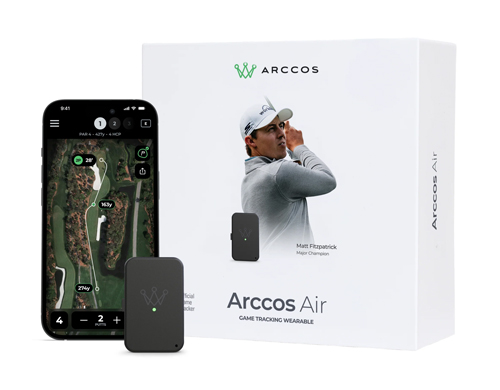
Arccos Air
Starting at $349.99
Arccos Air is a compact AI wearable, smaller than an Airpods case, that clips to your belt or slides in your pocket. Built-in motion sensors and GPS detect every shot automatically, powered by AI trained on 1.5 billion real golf shots.
Check AvailabilityWhat I changed
Almost nothing about my swing.
I started clubbing off the real numbers. 120 is now a 9-iron. 106 is the wedge. I did the same audit on every club in the bag and found smaller versions of the same problem in three of them, all in the same direction, all short.
That’s it. That’s the change. No lesson, no new equipment, no new thing to remember while I’m trying to swing.
Rounds eleven through twenty: 87, 88, 84, 89, 85, 86, 83, 87, 84, 85.
My index came down to 14.
Is it for you?
Arccos data across 1.5 billion shots shows that my improvement was normal. On average, members lower their handicap by 25% in the first year, which is basically exactly what I got.
The other thing I hadn’t expected: your phone stays in the bag. I had assumed tracking meant carrying a phone in my front pocket for four hours, which I did not want. The Air works on its own and syncs the round when you’re done.
The device is $349.99. Your first year of the app is included in that, and after the first year it’s $199.99 annually. That is a real, recurring cost and I would rather tell you now than have you find out at renewal. It works out to about $17 a month.
For me the math was straightforward, because in four years of not knowing what was wrong I had spent considerably more than that on clubs and lessons aimed at problems I did not have. But it is a subscription, and if you play six rounds a year it is probably not for you.
Two other things worth knowing. The sensorless tracking currently needs an iPhone. And if you want the club-by-club detail rather than the AI assigning clubs from your history, you can add the grip sensors later, though I haven’t felt the need.
What I’d say to a 19-handicap
You probably already have a theory about what’s wrong with your game. Mine was wrong for four years, and it was wrong in a specific way: I was blaming the shot I remembered instead of the shot that actually cost me.
Twenty rounds is what it took for the data to make that undeniable. I did not get better at golf in two and a half months. I found out what I’d been guessing wrong about.

Owen Loft
Owen moved from the competitive world of professional poker to digital marketing. Poker’s skillset of analytics, psychology, and calculated risk were a huge help in the transition. Outside of work, Owen loves to travel and has been to 35+ countries.

